Welcome to July. Officially now more than halfway through 2026!
It’s been a hectic year for the UK property market in general, and the ramifications have been felt here in Edgware, with a distinct lack of transactions hitting the Land Registry record here so far since January 1st – only 135, across that period. When it comes to Edgware property sales, the local 12-month average is 634 over the last five full years. Just 135 sales year to date in 2026 sounds starkly low.
If we double that number, to reflect what a 12-month period might look like, we get to just 270 transactions – well short of that five-year average.
But it’s not actually quite as simple as that.
Land Registry data suffers a lag, for a start. The most recent monthly record is April this year – which means that what you might assume to be a 6-month figure suddenly looks like only 4 months; in turn that extrapolated 270 sales for the year now looks more like 405, if we multiply four months’ data by three, rather than thinking it is six months we should multiply by two.
405 sales for the year would, of course, still be a long way short of 634, however. So, should Edgware homeowners be worried?
Let’s take a look at the figures and statistics – both nationally and locally – and see what story there is to be told…
The Story So Far and the Story in June
If you’ve been keeping up with news headlines this year, you may well be thinking that the property market has taken something of a battering this year. It’s true that there have been a number of events that have affected confidence, impacting things like inflation and mortgage rates.
The major conflict in Iran and the subsequent blocking of the Straits of Hormuz has felt like a constant in the news cycle since February, and that has had real-world consequences for markets – not least the property market.
Then we’ve had property market-related events, such as the implementation of the Renters’ Rights Act, which threatened to flood the market with ex-rental properties as landlords chose to exit the sector. More recently we’ve experienced a record-breaking heat dome covering much of the UK, the resignation of our Prime Minister, and now a World Cup to distract us all (or, at least, a great many).
Throw in a run of headlines on the theme of “transactions down 40% since 2021” or “an 8.8% year-on-year fall in May sales versus 2025”, and it would be no surprise if anyone concluded that the property market has gone quiet.
And yet…
The thing about data is that there is a lot of it. It really depends on what you’re looking at and whether there’s enough context provided around the edges of it.
If you read my article last week, this will sound like a bit of repetition. Transactions have dipped this year – that is true; 40% lower than the same period in 2021, also true. But alarming as that sounds, 2021 was a huge outlier as a year. A stamp duty holiday to galvanise the market, a backlog of movers who’d been prevented from moving home in 2020 due to lockdowns coming forward, and a surge of people fleeing cities for the rural life.
Not a normal market.
“Transactions down 40%” sounds catastrophic – but judged on its own terms, this year starts to look a lot healthier.
Here is what the rest of the data is showing:
- Values are up 3.8% on a £-per-square-foot basis, according to Dataloft.
- Asking prices are stable, only 0.5% lower than a year ago, according to Rightmove.
- Listing numbers are high, and more for sale stock is not a sign of a market in trouble; it’s a sign of confidence in the mechanics of the property market.
- Net sales agreed at their third-best year-to-date since 2017 – and net sales is more reflective of the market this year, as it reflects sales agreed since January 1st, as opposed to transactions, which in many cases come from sales agreed during the low activity period experienced in the latter months of 2025.
The market has its issues, but there is a lot to report that shows activity levels are actually higher than the prevailing narrative has suggested.
At least, on a national level, which is what those numbers refer to. So how about here in North London?
Closer to Home: The Edgware Property Market in July 2026
The national picture is one thing. What the market is doing locally is what matters to you if you are buying or selling a property in Edgware.
Here, property values aren’t quite in keeping with the national momentum – but they aren’t so far away. The average sale price has been £503,296 over the past 12 months, a 3% increase on the same time last year (compared to the 3.8% increase seen across the country).
As for general market activity – and particularly when it comes to new listings – the market here is also very much in line with the national mood. We may have seen an overall dip in transaction numbers – 18% lower year on year – but there are now 31% more properties for sale than at this time last year: 2,079 properties have come up for sale here in the past 12 months, and there are currently 1,063 properties available.
We can feel the momentum of the market changing in real time. But the market does still face problems. An increase in property listings is good news in terms of general seller sentiment – but the need to price sensibly to reflect buyer sentiment still stands. That 18% dip in transactions year on year reflects a certain caution from buyers. There is more choice for them, and they are being selective. Properties which price too ambitiously will remain unsold.
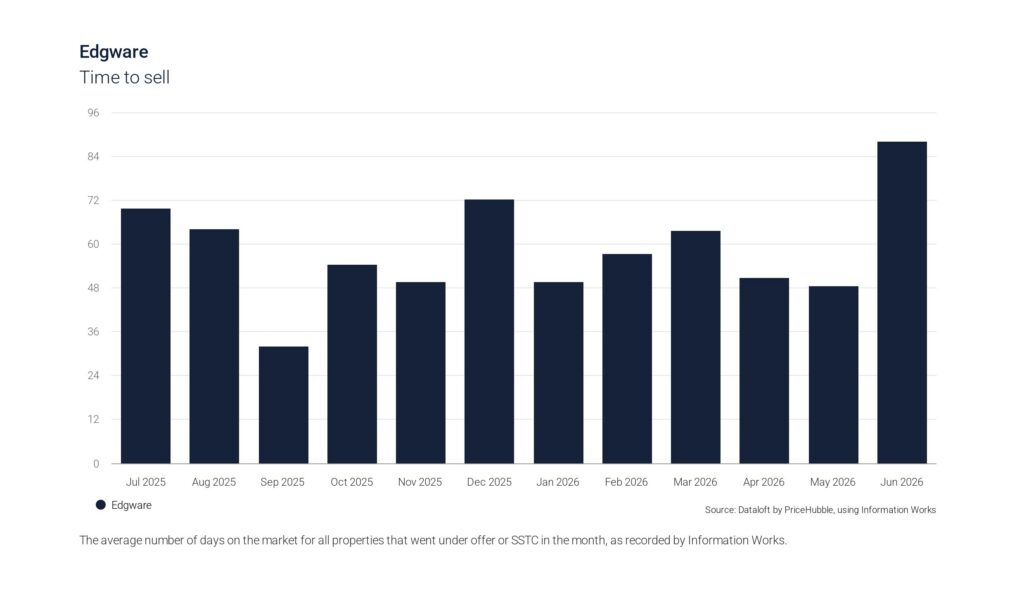
We are seeing evidence of this in the recorded ‘time to sell’; in June 2026, this has increased to 88 days – by far the lengthiest it has been at any point over the past year, and a huge increase on the 48 days it was recorded as having been only one month ago.
If you are thinking of moving home in Edgware, and especially if you want to move before the end of the year, now less than six months away, whilst it may sound absurd to many of you, now really is the time to have a frank conversation with a local Edgware property market expert like Petermans Estate Agents on Edgwarebury Lane.
The Bottom Line – and What We’re Watching Next
Once we strip away the comparisons to what was an artificially inflated 2021, you start to see a market picture that looks similar to most other years since 2017.
It is worth paying attention to national price movements – they inform market sentiment, as they tend to be reported in places that mass markets will consume such news.
Nevertheless, it is important to track what is happening locally. Not just in terms of sale prices, but in terms of the number of properties becoming available – which is a marker of intent – and also in terms of the composition of the market. It is important to be mindful of wider news stories, but not to be either stifled by them or overly buoyed up by them.
Noise isn’t the same as substance, and this year has had more noise than most. What matters is local market activity: do you have lots of competition for your home if you are thinking of selling, and are there enough buyers to go round? Have you taken this into account when setting your price?
Many sellers ask to launch at a slightly higher asking price to test the market. It is a strategy – but is it really the most sensible thing to do? How much might it hurt your chances in the long run? It can depend, ultimately, on your motivation – which you can determine by asking yourself a really simple question: what does it matter if I fail to sell my home?
So, what should we look out for over this coming month of July 2026?
The Labour leadership race – if indeed it is a race – which determines who our next Prime Minister is, will be an interesting one. Markets might react one way – but the public might react another way entirely.
One thing we will be paying close attention to is any clarification about Burnham’s plans for stamp duty vis-à-vis council tax (assuming he is, in effect, Prime Minister elect).
The idea of stamp duty reform is welcomed by many – but could it lead to more expense overall for homeowners? What I am referring to are the proposals to scrap stamp duty and council tax, and to replace both with an annual tax worked out as 0.48% of the total land and property value – welcomed by plenty, but not favoured by many who own properties worth more than £500,000. Around 55% of all properties for sale in Edgware currently are listed at a price in excess of £500,000, just to give you a flavour of what it might mean locally.
If you’re thinking about buying or selling in Edgware and the headlines over the past few years have given you pause for thought, our advice remains the same as ever: Don’t ignore the market, and don’t ignore the news, but do focus on your own needs and circumstances – because if you are serious about moving home, there are buyers out there.
Get in touch with our expert residential sales team in Edgware for a no-obligation chat about what it all means for your move.